Art in science entries will be listed here after approval by
the art in science chairs.
Image Entries:
Entry ID: 51DCASS-004
Shiny and Bright
Elizabeth Benitez
Air Force Research Laboratory
Nicholas Bisek
Air Force Research Laboratory
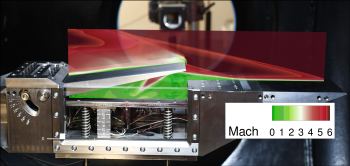
An overlay of Mach contours on a Partially Closed Cavity configuration tested in the AFRL Mach 6 Ludwieg tube.
Distribution Statement A: Approved for Public Release; Distribution is Unlimited. PA# AFRL-2025-5768; Cleared 12/18/2025.
Entry ID: 51DCASS-147
The Rotor Rain
Sidaard Gunasekaran
University of Dayton
Brock Greenwood
University of Dayton
Abdul Khan
University of Dayton
Megan Bender
University of Dayton
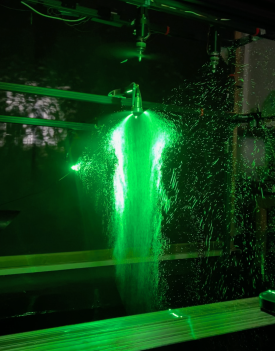
A rotary atomizer produces a fine spray beneath two propellers, where the rotor downwash shapes the droplets into a bright, sculpted plume. A laser sheet illuminates the mist, turning the flow into a glowing green curtain and revealing streaks, swirls, and regions of concentrated breakup. The image captures how rotating blades and atomization interact, tracing the hidden air motion through light scattered by thousands of airborne droplets. This test was conducted to study the effects of rotor wash on spray drift from the rotary atomizer.
Entry ID: 51DCASS-158
Flow Field of a Trapezoidal Nozzle
Andrew Russell
University of Cincinnati
Ephraim Gutmark
University of Cincinnati
Energy intensity plots depicting the flow field of a trapezoidal nozzle from the views of the lateral side (top) and major base (bottom). The top image shows two, distinct shock trains due to asymmetric expansion. The bottom image shows a line-of-sight integration of those two shock trains along with standing waves visible in the flow.
Entry ID: 51DCASS-160
Mapping Quasi-Chaotic Lunar Transport Pathways in the Earth-Moon CR3BP - A Chaotic Potpourri of Multi-Body Proportions
Jeremiah Specht
Air Force Institute of Technology
Robert Bettinger
Air Force Institute of Technology
Rachel Oliver
Air Force Institute of Technology
Bruce Cox
Air Force Institute of Technology
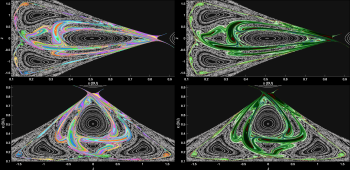
The Circular Restricted Three-Body Problem (CR3BP) is a simple but powerful model to describe and investigate trajectories within the Earth-Moon system. Leveraging a Poincaré map with the CR3BP is a useful method to define periodic, quasi-periodic, and quasi-chaotic trajectories. While most research focuses on periodic and quasi-periodic orbits, these typically remain around a single body or equilibrium point. This research focuses on the quasi-chaotic regions of the Poincaré map to explore trajectories that transfer to the lunar region. This research uses a Jacobi constant of 3.175 to ensure that Lagrange Point 1 (L1) is open to allow access to the Moon and Lagrange Point 2 (L2) is closed to keep trajectories inside the system. The focus of this research is the discovery and exploration of dynamical structures within the quasi-chaotic region defining trajectories that transfer from the Earth to the Moon. Exploring this dynamic structure exposes a framework to explain and map out the quasi-chaotic region. When the trajectories within these dynamical structures are propagated backward, they begin to fill in the quasi-chaotic or “dusty” region of the Poincaré map. Shown here is the result of propagating these trajectories backward for 30 revolutions, or Poincaré map crossings, over a standard Poincaré map in gray. Transferring to the Moon results in three possible outcomes: a collision with the Moon, a return back toward Earth, or a capture into an orbit around the Moon. This graphic illustrates these results in two distinct ways. The two maps on the left side of the graphic show different colors for each outcome at each revolution. The two maps on the right side of the image plot the collision, transfer, and orbit outcomes in red, blue, and green, respectively. The farthest back revolution is the lightest shade of each color, and the colors get darker with each revolution forward. The two maps at the top of the graphic are plotted with the standard orientation with x as the x-axis and ̇x as the y-axis. The two maps on the bottom switch axes to provide a slightly different perspective. While these maps appear chaotic, they reveal a previously hidden structure within the chaos enabling long-term behavior prediction for trajectories within this disorderly region.
Entry ID: 51DCASS-161
Carbon Fiber Rockets Ready for Launch
Nicholas Garbinski
Air Force Institute of Technology
Dr. Marina Ruggles-Wrenn
Air Force Institute of Technology
Image depicts a scanning electron micrograph of the fracture surface of a carbon/silicon carbide ceramic matrix composite. Fibers underwent oxidative degradation during mechanical testing, resulting in thinned structures that stand out from the surrounding matrix.
Entry ID: 51DCASS-162
Baffling Flow
John Brewer
Air Force Institute of Technology
Tanner Barber
Air Force Institute of Technology
This flow test specimens was designed to test the refinement of baffles for Additively Manufactured (AM) liquid-to-liquid heat exchangers. Designed in nTop software, this specimen employs a Gyroid infill and simulated water flow through one flow path depicted as time averaged velocity streamlines. In this section view, the viewer is looking along the secondary independent flow path.
Entry ID: 51DCASS-164
Momentum in Three Acts: Unsteady Dynamical Components of a 3D Compound SBLI
Anshul Suri
The Ohio State University
Datta Gaitonde
The Ohio State University
Jack McNamara
The Ohio State University
Turbulent shock/boundary-layer interactions (SBLI) are central to high-speed vehicle performance and present strongly multiscale, inherently unsteady flow physics. In fully three-dimensional configurations without a homogeneous direction, such as the compound double-fin SBLI considered here, interpreting this unsteadiness becomes particularly challenging. A useful framework is to decompose the fluctuating momentum density, (ρu)', into acoustic, hydrodynamic (vortical), and thermal (entropic) components, collectively designated as fluid-thermodynamic components. Leveraging high-fidelity simulations, this decomposition is used to expose the underlying components of three-dimensional unsteadiness and reveals emergent features, including a domino-like acoustic wavepacket that directly modulates the overall flow dynamics.
Entry ID: 51DCASS-165
Shock Train in a Circular Duct
Nathanael Wendel
The Ohio State University
Datta V. Gaitonde
The Ohio State University
Stuart I. Benton
Air Force Research Laboratory
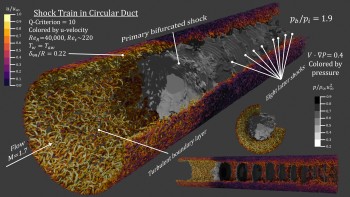
Scramjet isolators have historically consisted of rectangular cross-section or circular cross-section geometries. While each has advantages and disadvantages, the absence of corners in the circular case is desirable for its higher pressure recovery. This work compares canonical square and circular cases for assessment of unsteadiness, pressure recovery, and influence of corners.
Entry ID: 51DCASS-166
Transitional Flow over Prandtl-D Flying Wing
Patrick Hammer
Air Force Research Laboratory
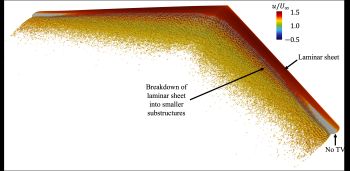
The unsteady flow over the Prandtl-D flying wing at a transitional Reynolds number of 200,000 is visualized using iso-surfaces of instantaneous Q-Criterion, colored by streamwise velocity for clarity. This image highlights the laminar sheet that transitions to turbulence. The lack of a tip vortex is noteworthy, as the wing operates with a bell-shaped lift distribution. This work elucidated features of the flow suggested by flight tests by NASA.
Entry ID: 51DCASS-167
Displaced by Dimension
Abigail Eaton
Air Force Institute of Technology
Arun Nair
Air Force Institute of Technology
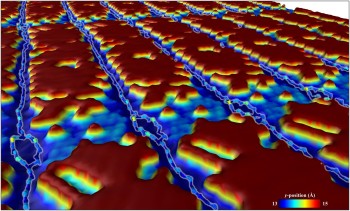
This image shows how inclusion of a 1D-2D hybrid carbon nanomaterial causes out-of-plane (dark blue) and in-plane (dark red) lattice discontinuity in Cu nanocomposites, which can lead to decreased stiffness despite the nanomaterial’s impressive mechanical properties. In the computational image, 1D-2D hybrids are highlighted for clarity and the Cu surface is a slice of a Cu-hybrid nanocomposite that is in-plane with the 2D component of the interstitial hybrids. The data utilized to create this image is from the journal article, “Interface and mechanical properties of 1D and 1D-2D carbon nanomaterials in copper matrix” from Abigail Eaton and Arun Nair published in the Journal of Materials Research and Technology (2025, vol. 39, pgs 4355-4365).
Video Entries:
Entry ID: 51DCASS-007
I’m too hot! No, wait, now I’m cold!
Nicholas Bisek
Air Force Research Laboratory
Elizabeth K. Benitez
Air Force Research Laboratory
The movie synchronizes high-speed focused-Schlieren images with time-accurate DES CFD results showing the Mach 1 sonic line (pink) and contours of total temperature for Mach 6 air interacting with a partially-closed cavity. The oscillatory shear-shock interaction seen in the Schlieren causes rapid heating (red) and cooling (blue) due to local changes in pressure work as the upstream boundary layer separation grows and contracts.
Entry ID: 51DCASS-017
Shock Train in a Rectangular Duct
Jack Sullivan
The Ohio State University
Datta V. Gaitonde
The Ohio State University
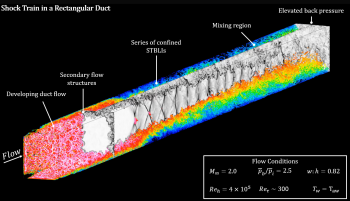
When designing a scramjet engine, one of the critical questions is what geometry ought to be used for the isolator region of the flow path. A common choice is to use constant area, rectangular ducts, as they are straightforward to machine and install on flight vehicles. However, the use of rectangular geometry inevitably alters the unsteadiness displayed by the shock train residing in the duct, with strong three-dimensional effects being introduced to the already complex flow. The presented work investigates the consequences of this three-dimensional unsteadiness, leveraging high-fidelity simulations to capture shock train dynamics over an extensive range of spatiotemporal scales.
Entry ID: 51DCASS-146
Ablation Saber
Sidaard Gunasekaran
University of Dayton
Daniel Curry
University of Dayton Research Institute
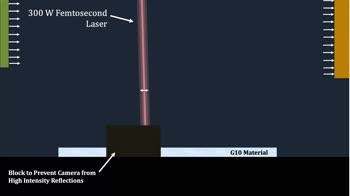
A 300 W femtosecond laser strikes a G10 surface, driving rapid ablation and launching a turbulent plume of ejected particles. This scene is captured with an event based camera, which records only changes in brightness rather than full image frames. The approach reveals the plume’s fast, filamentary motion and burst like structures in high contrast detail. What looks like a lightsaber is the laser path, while the surrounding speckled arcs trace material being ejected and accelerated into the air in real time.
Entry ID: 51DCASS-157
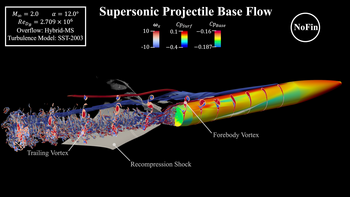
Supersonic Projectile Base Flow
Steven Murawski
The Ohio State University
Datta V. Gaitonde
The Ohio State University
The base flow of supersonic projectiles is important to characterize due to its large impact on drag, and therefore the range and top speed of vehicles. While these flows are typically studied without fins on the body, the addition of fins significantly alters the physics in the base region. The presented work utilizes data from a time-accurate hybrid multi-scale simulation to highlight key differences in the base flow between configurations with and without fins.
Entry ID: 51DCASS-163
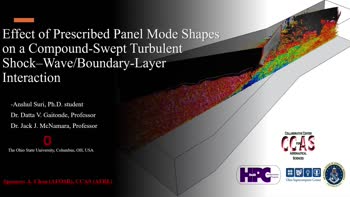
Effect of Prescribed Panel Mode Shapes on a Compound-Swept Turbulent Shock–Wave/Boundary-Layer Interaction
Anshul Suri
The Ohio State University
Datta Gaitonde
The Ohio State University
Jack McNamara
The Ohio State University
Fluid-structure interactions involving shock-wave/boundary-layer interactions (SBLI) play a critical role in high-speed vehicle design and performance. The dynamics of turbulent SBLIs can be substantially modified by surface deformations, altering shock motion, separation topology, and broadband unsteadiness depending on the flow receptivity to imposed perturbations. Using high-fidelity simulations, this study isolates the influence of specific panel mode shapes by prescribing controlled surface motions and examining the resulting flow response.
Entry ID: 51DCASS-168
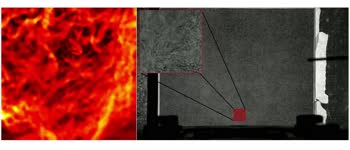
From Dots to Density: BOS Visualization of Combustion Refractive Index Gradients
Grace Fischer
University of Cincinnati
Ephraim Gutmark
University of Cincinnati
This video visualizes refractive index gradients within a combustion flow using Background Oriented Schlieren (BOS). The right side shows the raw footage of the background pattern being distorted by density variations. The left side displays the magnitude of these distortions quantified and shown using an intensity color map. Through the Gladstone–Dale relation and the ideal gas law, fluctuations in refractive index can be related to changing density and temperature, thus enabling high-speed, non-intrusive, quantitative diagnostics of the complex swirling combustion flow shown using only a camera and patterned background.
Entry ID: 51DCASS-169
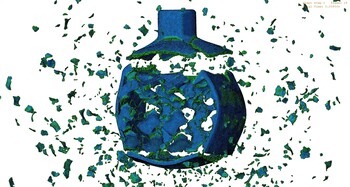
Ruptured Lattice
Tanner Barber
Air Force Institute of Technology
John Brewer
Air Force Institute of Technology
In support of research into additively manufactured heat exchangers with a triply periodic minimal surface (TPMS) lattice, there arose the desire to minimize the lattice wall thickness to promote heat transfer. This pressure vessel model was one of several generated in nTop with a Gyroid TPMS infill with varying wall thicknesses. An FEA simulation, conducted in Abaqus on this 0.5 mm wall model, predicted the burst pressure of the specimen as seen in the video.