
Below are items from the 50th DCASS, held 4 March 2025.
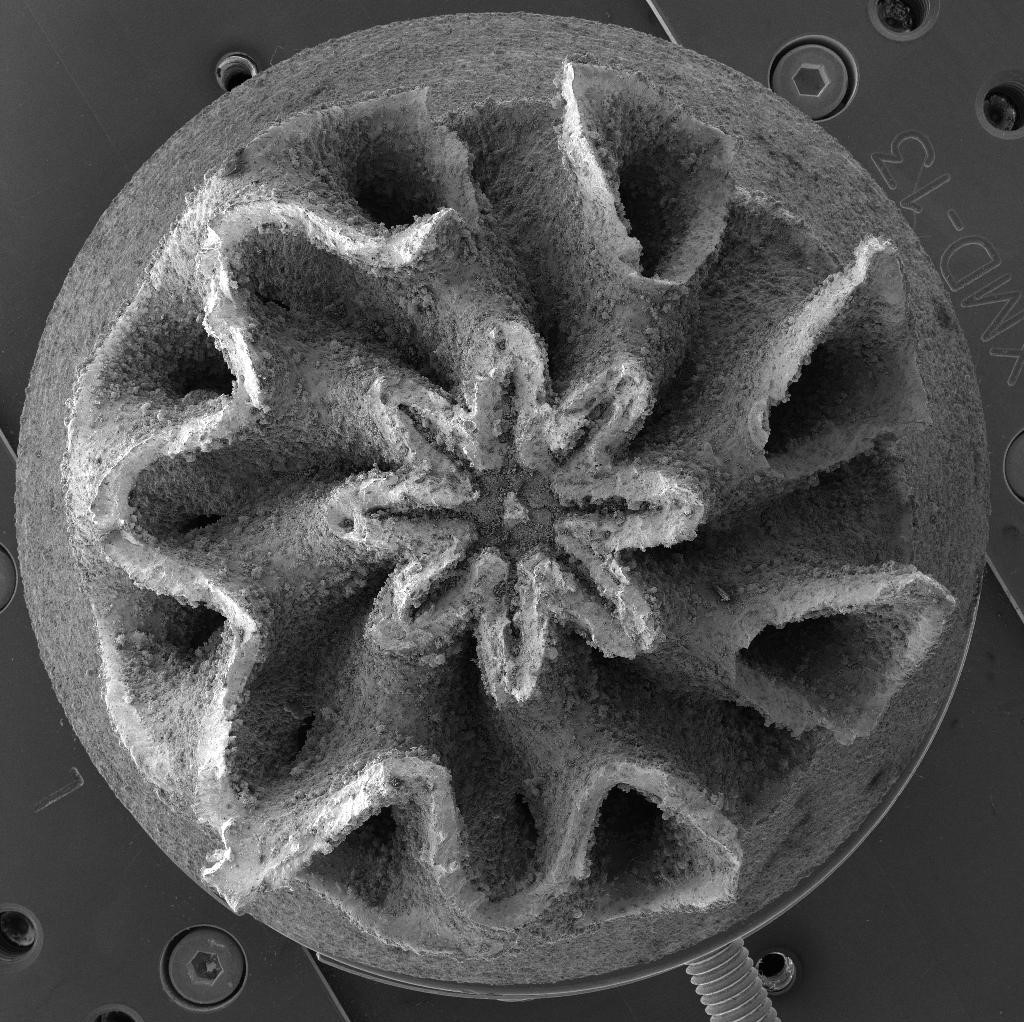
Flowering Fracture
Jay Patel, John Brewer, and Elizabeth Bartlett
Air Force Institute of Technology
This flower-like structure is the fractured cross section of a triply periodic minimal surface (TPMS) Inconel 718 specimen under combined tension-torsion loading. The TPMS geometry was generated with a 8-arc cylindrical cell map utilizing the gyroid unit cell. The specimen was additively manufactured, tested, and analyzed at the Air Force Institute of Technology in an effort to better understand how TPMS structures perform under combined loading. The image was captured with a scanning electron microscope utilizing the following settings: 11 kV, 15.6 mm view field, 14x magnification, 30.12 mm working distance.
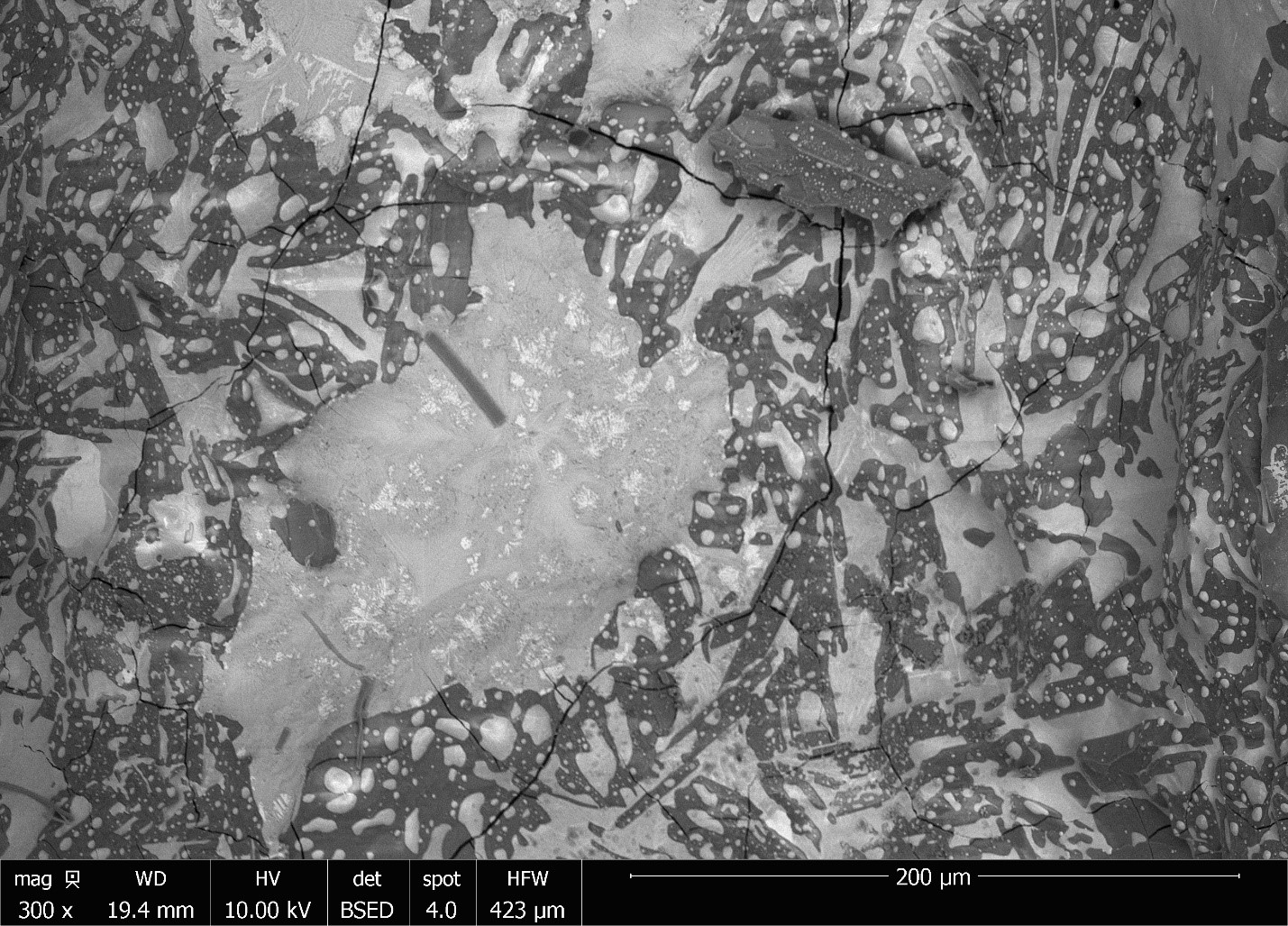
Caldera
Tess Panchyshyn and Marina Ruggles-Wrenn
Air Force Institute of Technology
SEM backscatter image of oxidation in an advanced SiC/SiC composite.
Turbulent Physics of a Shock Train Interaction
Jack Sullivan and Datta V. Gaitonde
The Ohio State University
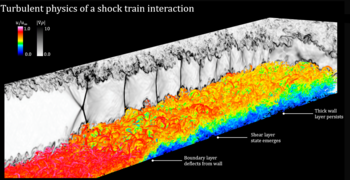
Shock trains are a class of internal flow shock wave/turbulent boundary layer interaction (STBLI), where incoming supersonic flow is processed to an elevated downstream backpressure through a series of individual STBLIs that occur in rapid streamwise succession. Each individual STBLI in the shock train inexorably changes the dynamics of the underlying turbulent boundary layer, altering local energetic scales and cascades. These changes can be investigated using high-fidelity simulations, as in a computational setting measurements of fine scale chaotic motions can be readily attained. The two visualizations in the video are taken from 3D snapshots of a shock train simulation, and aim to qualitatively show how turbulent boundary layer behavior changes as a result of the individual STBLIs in the system. The first visualization contains two numerical schlieren panes, highlighting the shock topology, and an isosurface of Q-criterion, colored by streamwise velocity. The Q-criterion function depicts coherent rotational eddies within the turbulence, and underlines how observed changes to turbulent statistics are a result of dynamic changes to individual boundary layer structures. The second visualization contains panes of streamwise velocity and renderings of instantaneous separation regions. Animation of these fields demonstrates how the outer shock waves interrupt classical behaviors in wall bounded turbulence, as shock induced separations disrupt the well-known near wall streak cycle. Subsequent shock waves perturb the boundary layer, and create weaker, yet still prominent separated regions. At further downstream locations, shock waves have become sufficiently weak that the mean flow shear begins to recover, and the streak cycle begins to re-emerge.
Upstream Travelling Sound Waves (Screech) Visualization at
Core Jet NPR 2.7
Kaurab Gautam and Ephraim Gutmark
University of Cincinnati
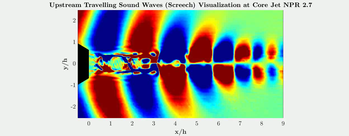
This movie shows the screech tones in a supersonic cold jet emanating from a rectangular converging-diverging nozzle with an aspect ratio of 2:1. The jet exhibits pronounced screech tones in overexpanded flow conditions. At a nozzle pressure ratio (NPR) of 2.7, the jet produces screech at a frequency of approximately 8900 Hz. Although the core jet flows from left to right, the screech waves propagate upstream. When the upstream-traveling waves reach the nozzle exit, they perturb the flow, inducing instability waves that travel downstream. These instability waves interact with the shock cells in the jet, generating additional upstream travelling screech noise. This feedback loop perpetuates high-amplitude screech tones, significantly amplifying the noise produced by the cold supersonic jet, where the core jet temperature matches the ambient. The interaction of shock structures with the instability waves is critical in driving the feedback mechanism that sustains the screech tones.
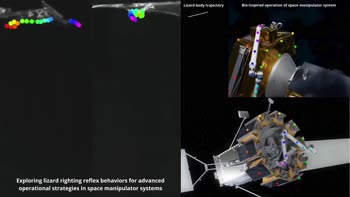
From Nature to Orbit: Bio-Inspired Motion for Robotic
Arm-Equipped Satellites
Alhim Adonai Vera Gonzalez, Daegyun Choi, and Donghoon Kim
University of Cincinnati
The lizard falls in slow motion, with pose estimation tracking its body and tail dynamics to showcase its natural righting reflex. A robotic simulation mimics the lizard's mid-air righting motion, applying bio-inspired control strategies to stabilize a robotic arm-equipped satellite. The estimated pose trajectory offers critical data, enabling the space manipulator system to adjust its motion effectively. This visual comparison, emphasizing morphological similarities, highlights the potential of animal-inspired strategies to improve satellite stabilization and precision in microgravity.