
Below are items from the 51st DCASS, held 10 March 2026.
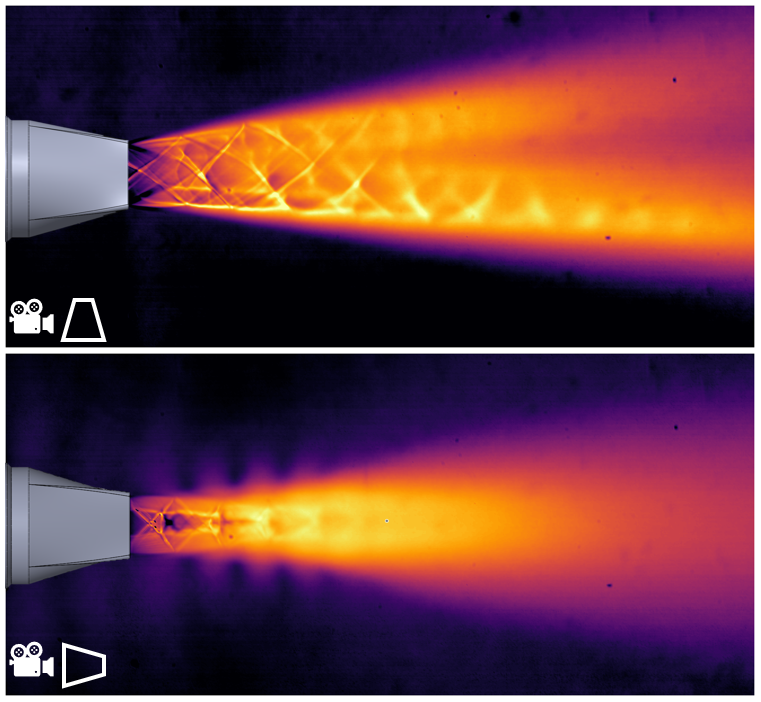
Flow Field of a Trapezoidal Nozzle
Andrew Russel and Ephraim Gutmark
University of Cincinnati
Energy intensity plots depicting the flow field of a trapezoidal nozzle from the views of the lateral side (top) and major base (bottom). The top image shows two, distinct shock trains due to asymmetric expansion. The bottom image shows a line-of-sight integration of those two shock trains along with standing waves visible in the flow.
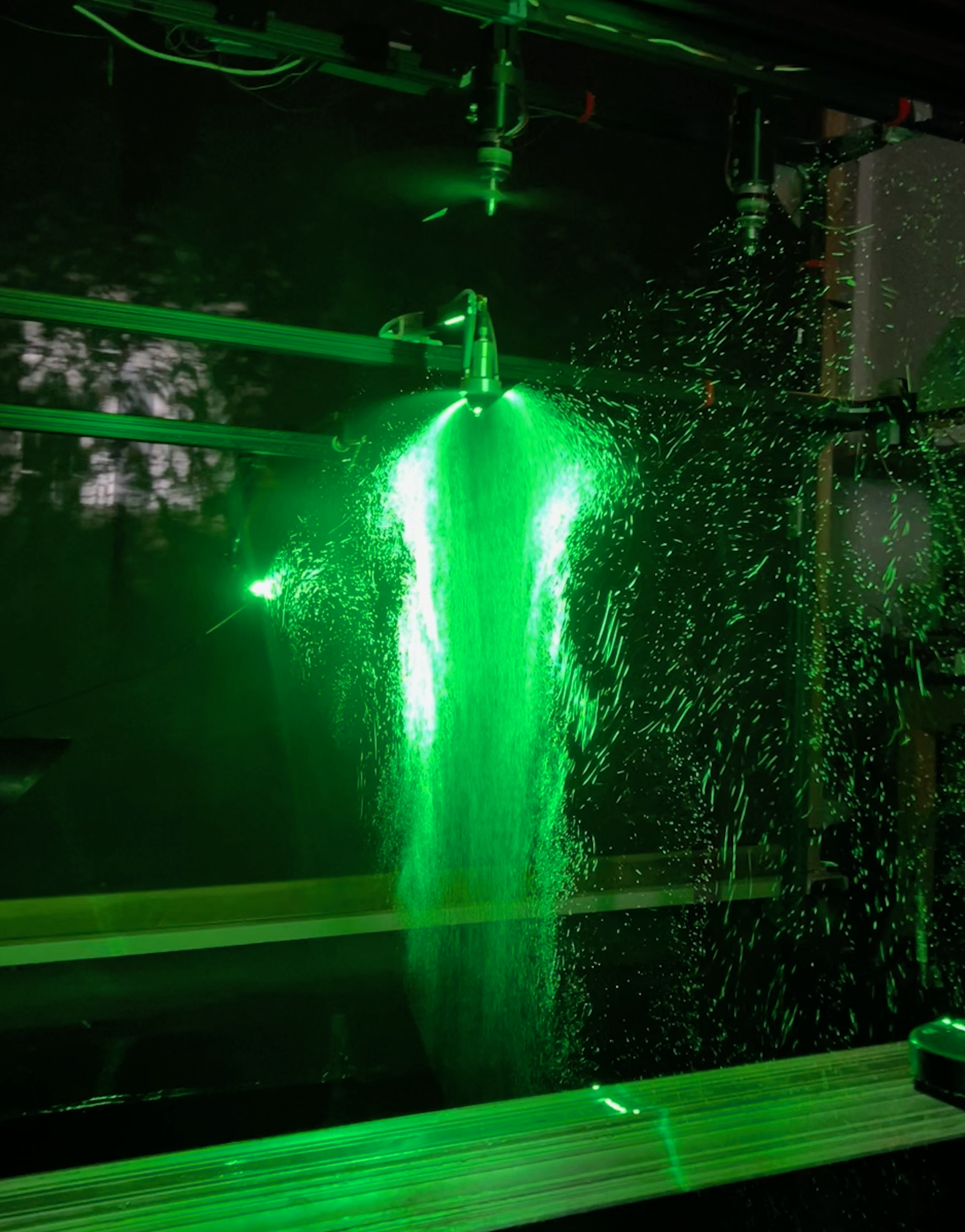
The Rotor Rain
Sidaard Gunasekaran, Brock Greenwood, Abdul Khan, and Megan Bender
University of Dayton
A rotary atomizer produces a fine spray beneath two propellers, where the rotor downwash shapes the droplets into a bright, sculpted plume. A laser sheet illuminates the mist, turning the flow into a glowing green curtain and revealing streaks, swirls, and regions of concentrated breakup. The image captures how rotating blades and atomization interact, tracing the hidden air motion through light scattered by thousands of airborne droplets. This test was conducted to study the effects of rotor wash on spray drift from the rotary atomizer.
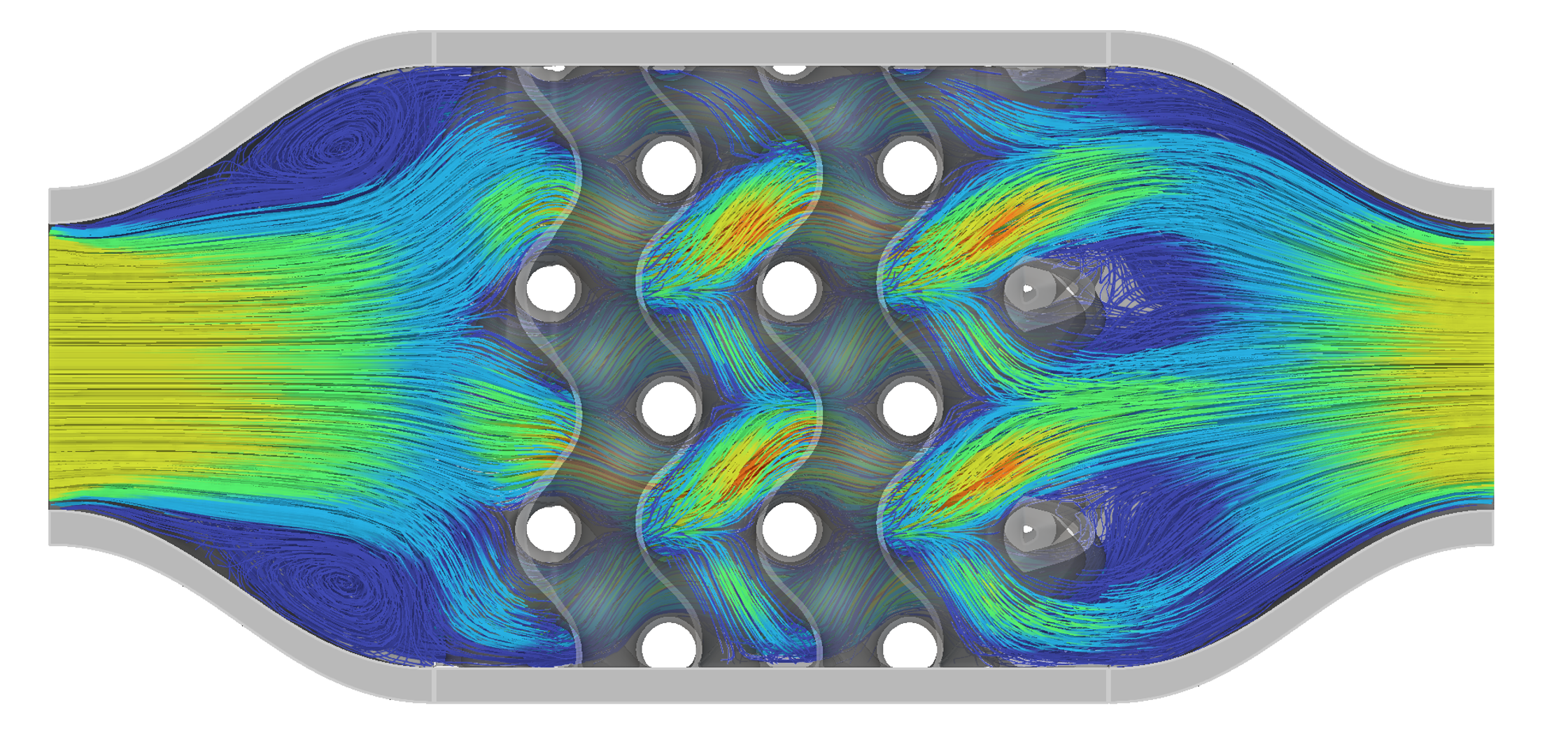
Baffling Flow
John Brewer and Tanner Barber
Air Force Institute of Technology
This flow test specimens was designed to test the refinement of baffles for Additively Manufactured (AM) liquid-to-liquid heat exchangers. Designed in nTop software, this specimen employs a Gyroid infill and simulated water flow through one flow path depicted as time averaged velocity streamlines. In this section view, the viewer is looking along the secondary independent flow path.
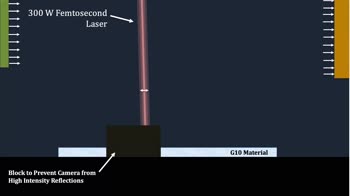
Ablation Saber
Sidaard Gunasekaran
University of Dayton
Daniel Curry
University of Dayton Research Institute
A 300 W femtosecond laser strikes a G10 surface, driving rapid ablation and launching a turbulent plume of ejected particles. This scene is captured with an event based camera, which records only changes in brightness rather than full image frames. The approach reveals the plume's fast, filamentary motion and burst like structures in high contrast detail. What looks like a lightsaber is the laser path, while the surrounding speckled arcs trace material being ejected and accelerated into the air in real time.
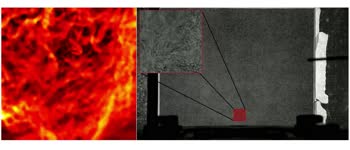
From Dots to Density: BOS Visualization of Combustion
Refractive Index Gradients
Grace Fischer and Ephraim Gutmark
University of Cincinnati
This video visualizes refractive index gradients within a combustion flow using Background Oriented Schlieren (BOS). The right side shows the raw footage of the background pattern being distorted by density variations. The left side displays the magnitude of these distortions quantified and shown using an intensity color map. Through the Gladstone-Dale relation and the ideal gas law, fluctuations in refractive index can be related to changing density and temperature, thus enabling high-speed, non-intrusive, quantitative diagnostics of the complex swirling combustion flow shown using only a camera and patterned background.
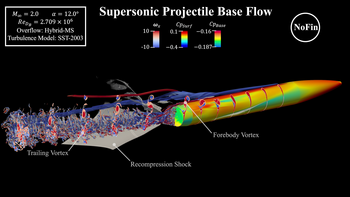
Supersonic Projectile Base Flow
Steven Murawski and Datta V. Gaitonde
The Ohio State University
The base flow of supersonic projectiles is important to characterize due to its large impact on drag, and therefore the range and top speed of vehicles. While these flows are typically studied without fins on the body, the addition of fins significantly alters the physics in the base region. The presented work utilizes data from a time-accurate hybrid multi-scale simulation to highlight key differences in the base flow between configurations with and without fins.